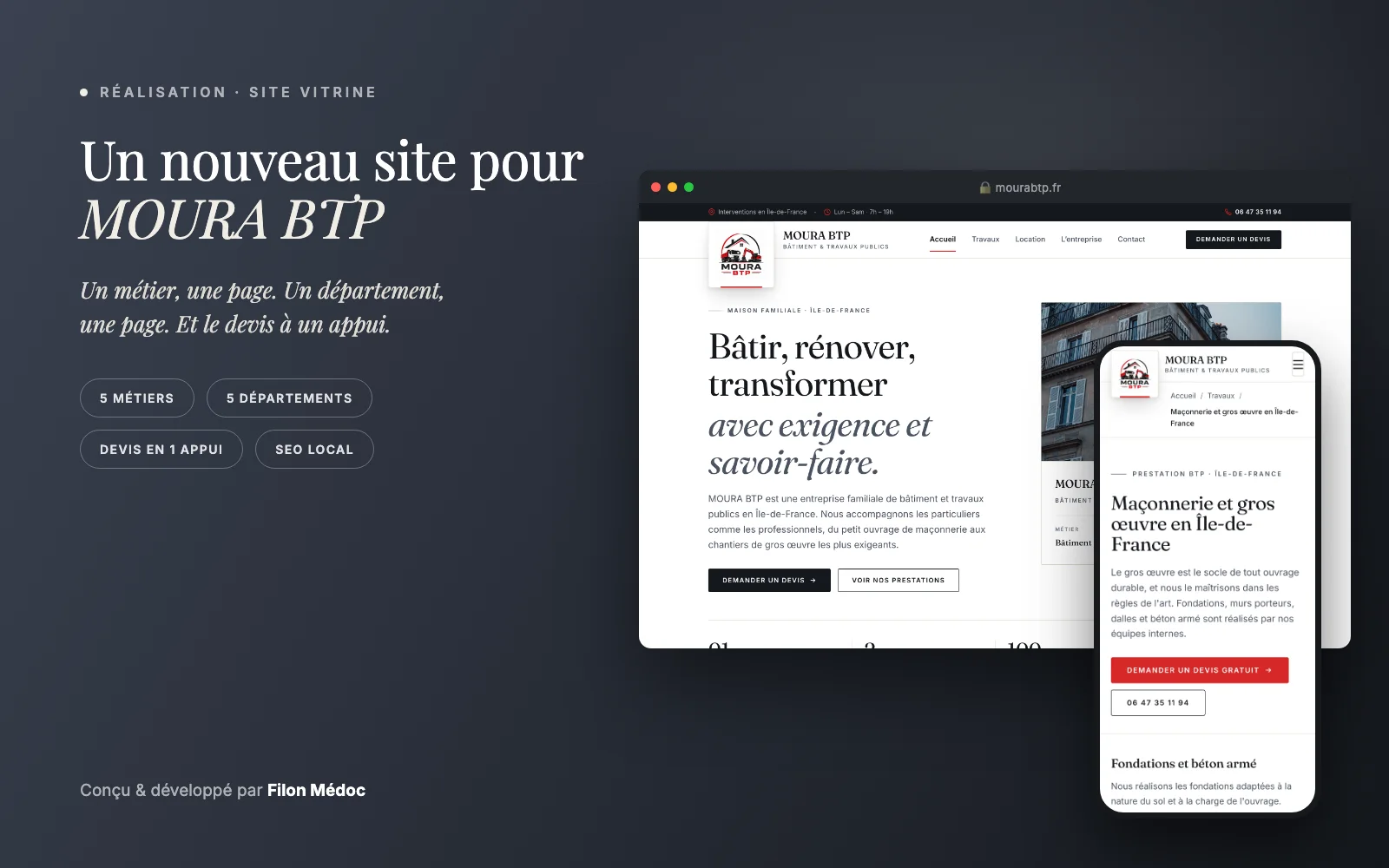
MOURA BTP is a family building and civil engineering firm based in Paris, working across the whole Île-de-France region with its own crews and its own plant: new build, renovation, demolition, masonry, underpinning, earthworks, and plant hire with an operator.
The site is live: mourabtp.fr. Here is the reasoning behind its structure.
Nobody searches for “construction”
That is the starting point, and it holds for nearly every building trade. A customer does not type the name of your sector. They type their problem and their location.
“Underpinning Val-d’Oise”. “Earthworks contractor Seine-Saint-Denis”. “Bricklayer Paris 15”. “Interior demolition Hauts-de-Seine”.
A site that settles for a handsome home page listing seven services exists on none of those searches. It exists on “MOURA BTP”, which is to say only for people who already know the firm. In other words, it is useless for finding new customers.
The structure of the site follows entirely from that.
One page per trade, one page per area
The site has two families of substantial pages.
On one side, the trades: new build and renovation, demolition, masonry and structural work, underpinning, earthworks, plus plant hire with an operator. Each has its page, covering what it really involves, how the job unfolds, and what makes one intervention different from another.
On the other, the areas: Paris, Hauts-de-Seine, Seine-Saint-Denis, Val-de-Marne, Val-d’Oise. One page per département where the firm works most.
The photocopied-pages trap
This is where a lot of trade websites sabotage themselves, while meaning well.
The tempting shortcut is to write one page, then duplicate it fifty times swapping the town name. “Bricklayer in Argenteuil”, “Bricklayer in Cergy”, “Bricklayer in Pontoise”, word for word identical. These are called doorway pages, Google spots them very well, and the outcome is not merely that they fail to rank: they can pull down the credibility of the entire site.
So each area page says something true and specific. Parisian building stock is not that of the Val-d’Oise: period buildings, narrow access, party walls, neighbours to respect, permits. The typical jobs differ, and so do the constraints. An area page that could not be copied across to the neighbouring département is an honest area page.
The rule is easy to remember: if you can swap the town name without the text becoming false, the text is saying nothing.
The quote is requested by phone
In the building trade, the shortest path between worry and an appointment is a phone call.
So the number sits at the top of every screen, clickable, next to the opening hours and the coverage area. On mobile, one tap is enough. The “request a quote” button is constant too, for people who write in the evening or prefer to put their request in writing.
Nothing clever about it, and that is exactly the point: every step added between the intent and the action costs you customers.
What Google needs to understand about a firm that travels
A building firm does not receive the public in a shop: it works at people’s homes. Its structured description says so explicitly, in a language search engines read without ambiguity: the nature of the business, its address, its phone number, its opening hours, the list of its services, and above all the area served, département by département.
That is what lets Google understand that a search made from Sarcelles concerns this firm, even though its address is in Paris.
Twelve questions, the ones from the job
The frequently asked questions page does not copy a list found elsewhere. It gathers what people genuinely ask a building firm: are quotes free, how quickly, do you handle emergencies, do you use in-house crews or subcontractors, what guarantees, what timescales.
Those answers do double duty. They reassure a hesitant visitor, and they answer searches phrased as questions, which are becoming more common.
No database at all
The site is delivered as pages ready to display. There is no database, no admin interface, and no plugins to update every month.
In practice: nothing to back up, nothing to corrupt, and no entry point for the automated attacks that constantly sweep sites built on the most widespread platforms. The pages are also far faster, since there is nothing to compute at the moment of the visit.
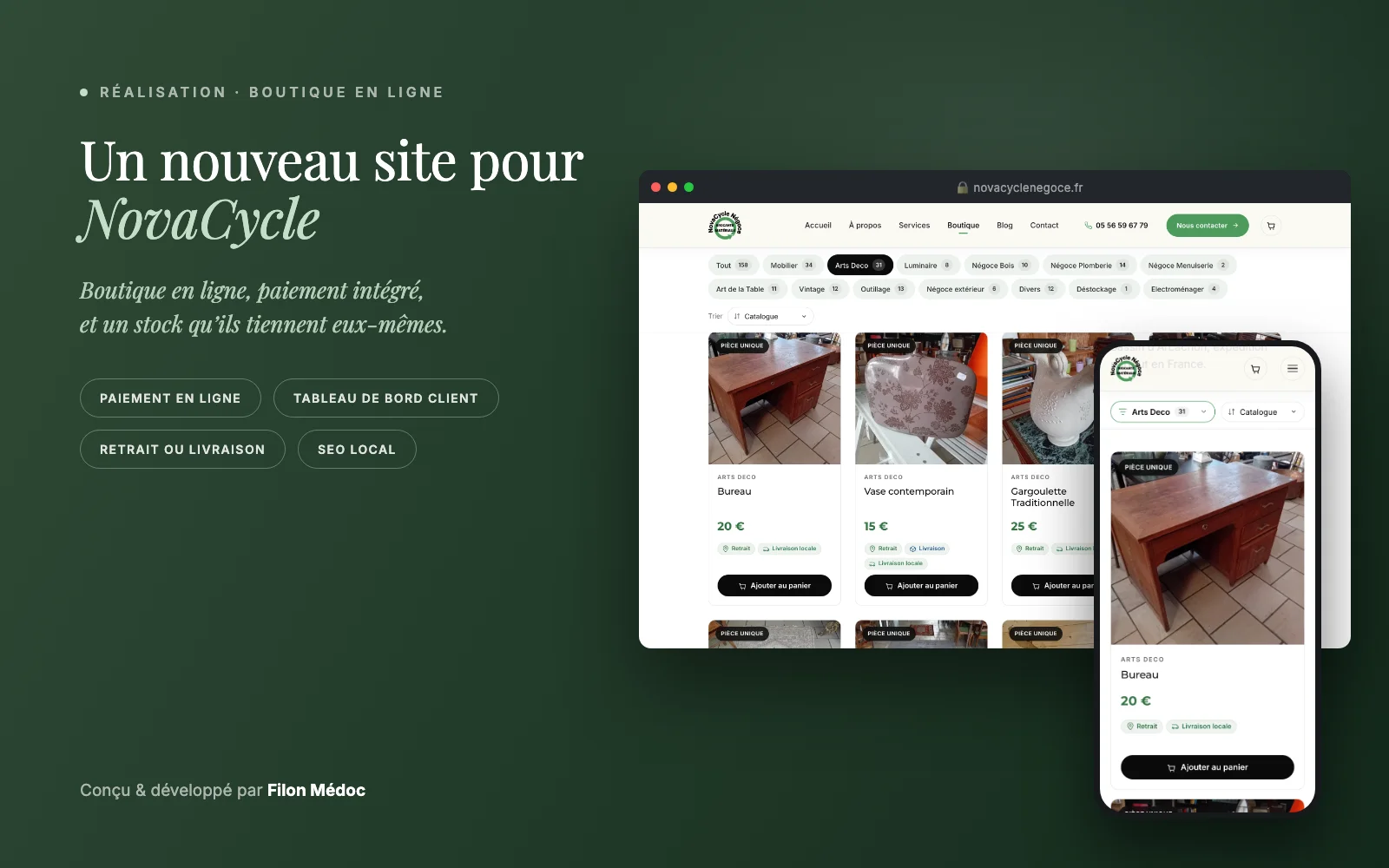
The trade-off is accepted: changing a piece of text goes through us. For a firm whose content moves once or twice a year, that is the right compromise. For a shop whose catalogue changes daily it would be the wrong one, and we then install a dashboard, as we did for the NovaCycle Négoce shop.
The choice is not ideological: it depends on how often your content changes. It is one of the first questions we ask.
What another tradesperson can take from this
- Your customers search for a problem and a place, not an industry. Your site has to exist on those searches.
- One page per area, yes. Fifty photocopied pages, no. If the text stays true when you change the town name, it serves no purpose.
- The phone still rules in construction. Make it clickable everywhere, no exceptions.
- Describe your coverage area to Google, explicitly. Your address does not say where you work.
And for your firm
We build sites for tradespeople and contractors on this logic: your trades, your area, your jobs, not a repainted template. Prices are published, the quote is free within 24 hours, and the code is yours for life.
Everything is set out on the website design page. For the general version of the sector’s best practice, we wrote a full guide: website for tradespeople.
And if you have a job in the Paris region, MOURA BTP answers the phone.
Frequently asked questions
- Do you need one page per town to be found locally?
- Not per town, no. One page per area you genuinely cover, yes, provided it says something true and specific: the type of building stock, the access constraints, the usual jobs. Identical pages where only the town name changes are doorway pages: Google recognises them, and they can drag the whole site down.
- Is a website enough to bring in customers in the building trade?
- It does half the job. The other half happens on your Google business profile, your customer reviews and links from serious trade directories. A well-built site without a maintained Google profile stays underused, and the reverse is true as well.
- Contact form or phone number?
- In the building trade the phone wins nearly every time. A homeowner with a worrying crack calls, they do not fill in a form. So the number has to be clickable at the top of every screen. The form keeps its use for non-urgent requests and for people who write in the evening.
- What does a brochure site with no database actually change?
- There is nothing to update, nothing to back up and no entry point for automated attacks. Pages are delivered as they are, which makes them very fast. The trade-off is that a content change goes through us, which suits a site whose text moves once or twice a year perfectly well.
- How long does it take to launch a contractor's website?
- Two to four weeks once the site photos and legal details are ready. What lengthens a project is almost never the development: it is the time needed to gather the visuals and sign off the trade copy.
Want a hand-coded website, with no opaque quote?
Published prices, code yours for life, no lock-in. Free quote within 24 hours.
Build my website