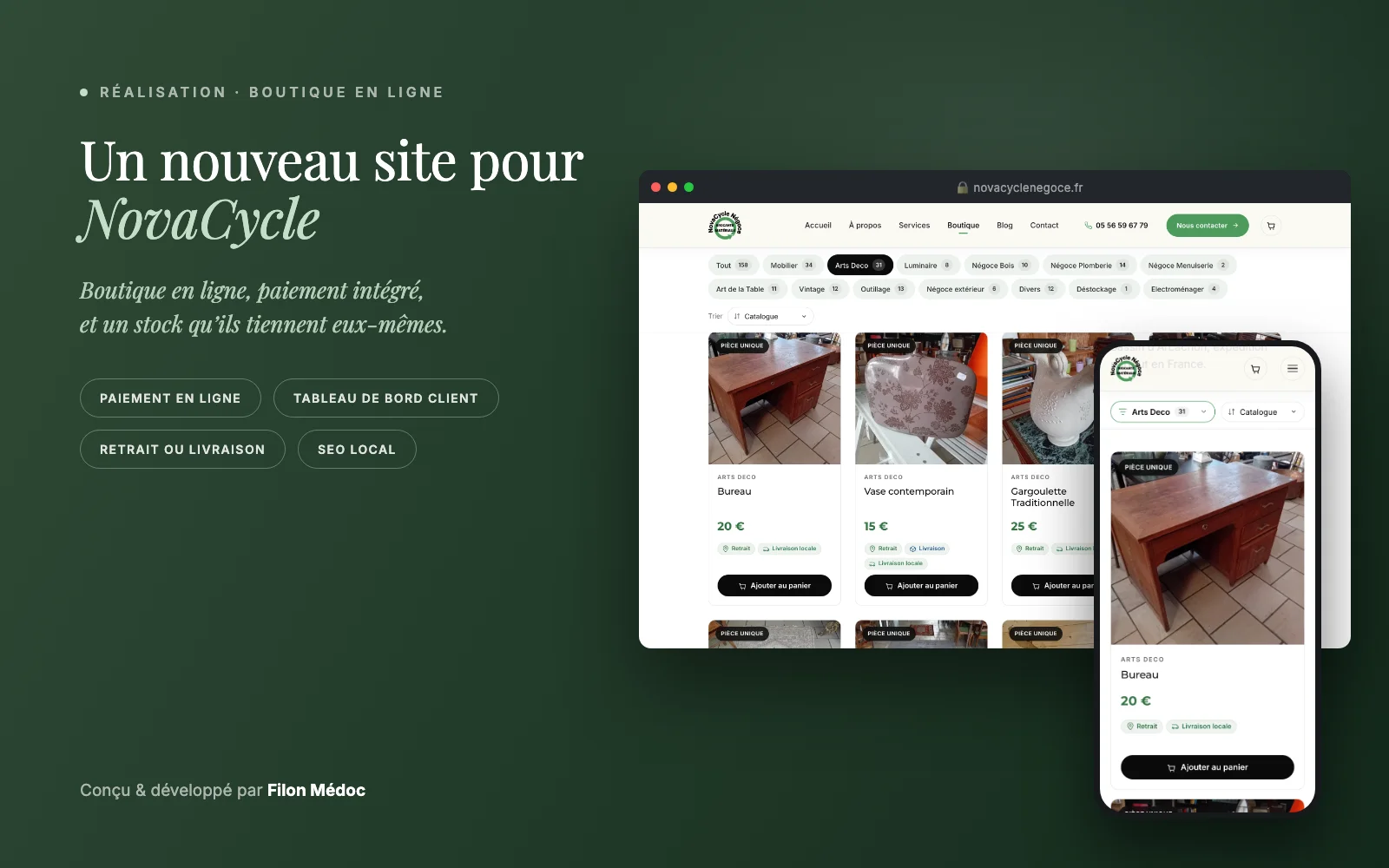
NovaCycle Négoce is a yard in Saint-Vivien-de-Médoc, a few minutes from the Soulac road. It sells new and clearance building materials, antique furniture, rewired light fittings and second-hand finds. The business opened at the end of 2025 and sells both to builders and to bargain hunters.
The site is live: novacyclenegoce.fr. Here is why it was built this way.
The real problem: stock that never repeats
A classic online shop sells references. You have a hundred of the same blue T-shirt in medium, you sell them, you restock, and the product page stays put for years.
None of that applies here. There is one teak sideboard. There is one lot of clearance roof tiles. The cane chair sold on Tuesday is never coming back. The catalogue turns over with each delivery, weekly, sometimes daily.
That changes two things, and they govern the whole project:
- The shop has to be able to count to one. Selling the same one-off piece twice means a refund, a disappointed customer and an awkward conversation.
- Whoever sells has to be whoever publishes. A catalogue that moves every day cannot depend on an agency you call for each new item.
Selling a one-off is not selling a mass-produced item
The dreaded scenario is simple: two visitors open the same product page in the same minute, both add it to their basket, both pay.
So the shop reserves the item the moment it goes into a basket, for a limited time. During that window it is no longer available to anyone else. If the basket is abandoned, the item releases itself and goes back on sale. The basket itself is recalculated on the server at the moment of payment: the price and availability shown in the browser prove nothing, only the real state of the stock counts.
This is invisible to the visitor, and it is nevertheless the heart of the work. You recognise a badly built second-hand shop by exactly this: it takes orders it cannot fulfil.
The dashboard: the client is entirely self-sufficient
NovaCycle runs its own catalogue. From a protected area, the team creates a product, writes its description, sets its price, uploads photos from the phone that just took them, picks its category and its quantity. The page is live straight away.
Categories are created on the fly too: furniture, lighting, tableware, timber, plumbing, joinery, tools, clearance, vintage. The day a new aisle appears in the yard, it appears on the site without anyone having to write to us.
This is the point to be blunt about with any trader: a site you cannot edit yourself is a site that will be out of date within six months. Not because the agency is bad, but because nobody calls their agency to add a €40 chair.
Payment happens on the site, not somewhere else
Card, Apple Pay, Google Pay, bank transfer: the customer pays on novacyclenegoce.fr, without being shipped off to a marketplace that would offer them something else along the way.
Two concrete consequences for the trader. The money arrives in their account, with no intermediary taking a cut of every sale. And the customer stays theirs: the email address, the history and the trust are not the property of a platform that can raise its rates next year.
After the order, the buyer follows their file through a private link of their own, and receives their confirmation and then their invoice automatically. The team, meanwhile, watches orders land in the dashboard.
Collection or delivery, decided product by product
A chest of drawers does not go in a parcel. A box of screws does.
So each product carries its own fulfilment method: collection from the yard only, delivery available, or both. The visitor sees what is possible before paying, and the trader does not end up having to ship a cast-iron bath because the site promised it.
That kind of setting looks tiny from a distance. It is precisely what separates a shop built for a trade from a shop bought off the shelf.
Being found when the catalogue moves constantly
Search visibility for a shop whose pages appear and disappear demands its own discipline.
The pages that carry the search work are therefore the stable ones: the home page, the category pages, the services page, the about page, the blog. They are the ones that talk about building materials, clearance and second-hand trade in the Médoc, and they do not move. Product pages come as reinforcements and are allowed to be short-lived.
On top of that sits the usual groundwork: a structured description of the business for Google (address, opening hours, sector), a clean address per page, an up-to-date sitemap, and text written for what people actually type, along the lines of “clearance building materials Médoc” rather than “supply solutions”.
The site also acts as a shop window for people who will come to the yard and never order online. That is a large part of the work, and it cannot be measured in completed baskets.
And respect for visitors
The site sets no advertising trackers, and therefore shows no cookie banner to dismiss before you can see a price.
This is not a flourish: it is faster, it is compliant without workarounds, and it avoids forcing an extra click on someone who just wanted to look at a sideboard.
What another shop can take from this
If you run a yard, a second-hand shop, a clearance business or any trade whose stock is not standardised, four points from this project are worth keeping:
- Count to one. A shop that does not reserve the item in the basket will make you sell the same piece twice.
- Insist on self-sufficiency. If you cannot publish a product from your phone at six in the evening without calling anyone, the site will not stay alive.
- Fulfilment belongs to the product, not to the order. That is what makes it possible to sell both screws and fireplaces.
- Let your stable pages carry the search work. Your product pages are mortal, your categories are not.
And for your business
We build online shops on exactly this logic: your stock, your fulfilment methods, your way of working, not a repainted template. Prices are published, the quote is free within 24 hours, there is no commission on your sales, and the code is yours for life.
Everything is set out on the website design page. If you are still weighing a simple brochure site against a real shop, we wrote a guide for that: brochure site or online shop.
And if you are passing through the northern Médoc, the NovaCycle Négoce yard is worth the detour.
Frequently asked questions
- Can you sell one-off items online?
- Yes, provided the shop counts stock to the unit and locks the item the moment it goes into a basket. Without that, two customers can pay for the same piece thirty seconds apart and one of them has to be refunded. It is the single most important technical point for a second-hand or clearance shop, and the one generic platforms handle worst.
- Do you have to call us to add a product to the shop?
- No. The client has a dashboard where they create products, categories, prices, photos and quantities, from a phone or a computer. That is the only way a shop whose stock changes daily stays accurate. We work on the structure of the site, not on its day-to-day content.
- Which payment methods can you accept on your own site?
- Card, Apple Pay, Google Pay and bank transfer. Payment happens on the site, with no redirect to a marketplace, and the money lands directly in the trader's account. Our studio takes no commission on sales.
- Can you offer collection in store rather than delivery?
- Yes, and it is set product by product. A heavy or bulky item can be offered for collection only, while a small object stays shippable. It is more honest for the customer, and it avoids orders that cannot be fulfilled.
- How much does an online shop like this cost?
- The foundation is priced publicly on our website design page, and the shop module is added to it. The price is published, the quote is free within 24 hours, and the code is yours for life. There is no commission on sales and no compulsory platform subscription.
Want a hand-coded website, with no opaque quote?
Published prices, code yours for life, no lock-in. Free quote within 24 hours.
Build my website