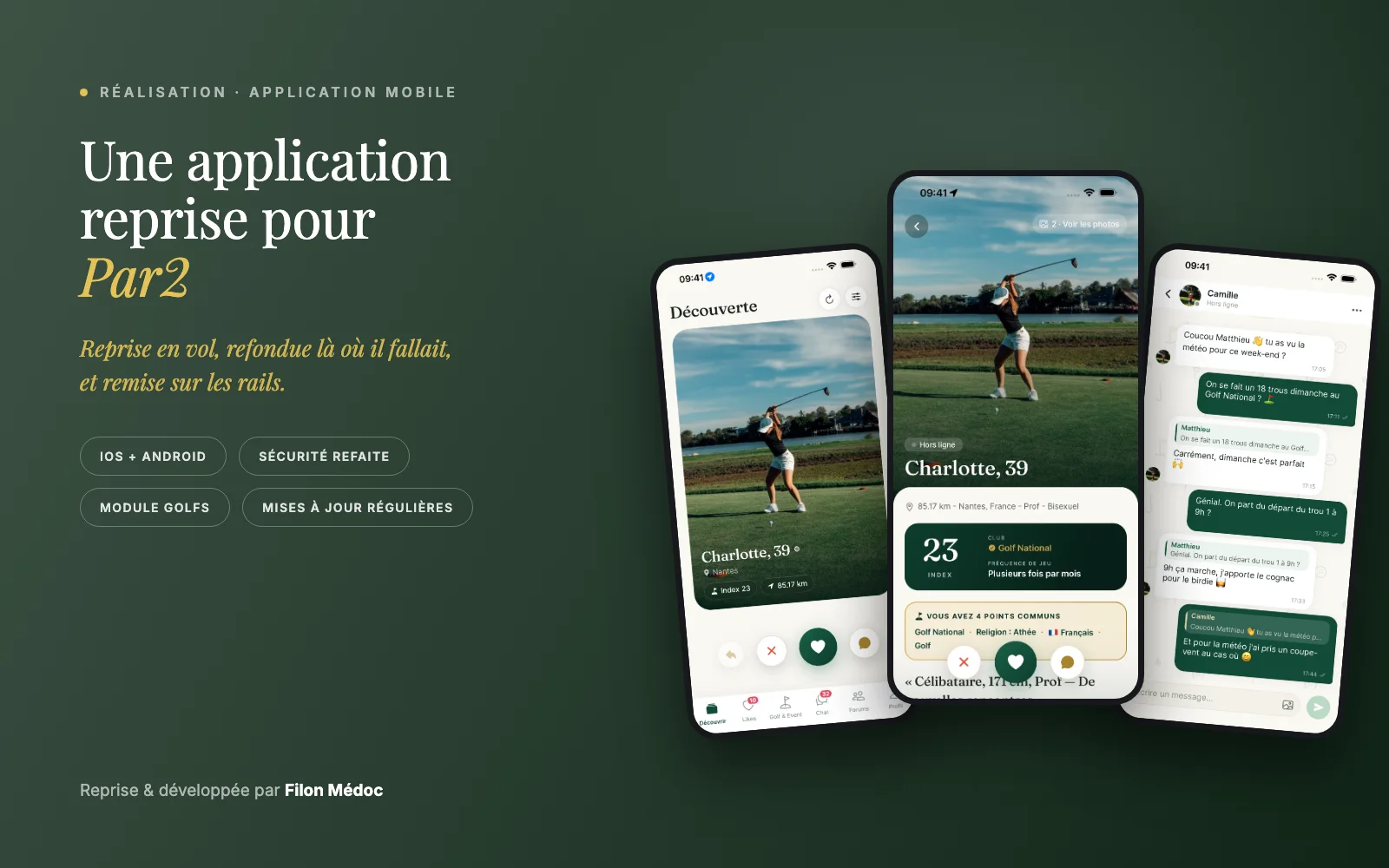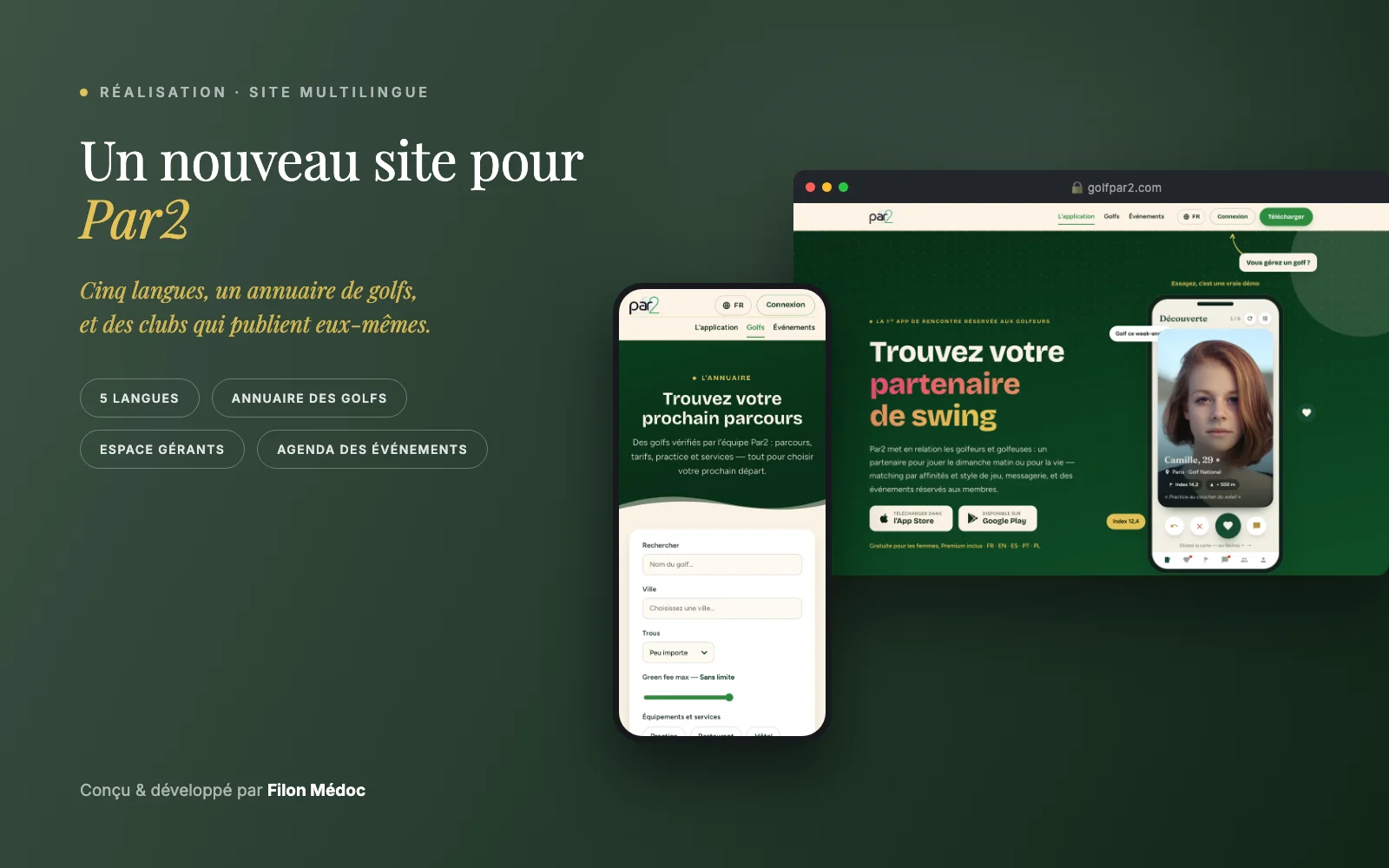
Par2 is a mobile dating app for the golf community. Its site, golfpar2.com, is not a simple presentation page with two download buttons: it carries a directory of golf courses, an events calendar and an area reserved for club managers, all in five languages.
Here is why it was built this way.
Two audiences with nothing in common
The website of a mobile app almost always serves two opposing audiences, and that is where most of them fail, by trying to serve only one.
On one side, the player. They arrive out of curiosity, they want to understand in ten seconds what the app does, what it looks like, and whether people like them use it. They will read nothing long.
On the other, the golf club manager. They may never download the app. What interests them is that their club appears in front of golfers, with its photos, its courses, its green fees and its competitions. They want to know what it costs, what it demands, and how long it takes.
So the site is organised into two distinct paths that do not tread on each other: the top of the page addresses the player, dedicated sections address managers, with their own call to action and their own area.
Show the app, do not describe it
To convince a player, the best sentence is the one you do not write.
The home page contains a playable demonstration of the app’s core mechanic: you swipe through profiles, exactly as in the app itself. It runs entirely in the browser, with fictional profiles, connected to nothing.
That is a design decision rather than a feat of engineering: a visitor who has handled the idea for five seconds has understood the product better than after three paragraphs.
Five languages, not a translation button
The site exists in French, English, Spanish, Portuguese and Polish.
It is worth being precise about what that means, because this is where marketing vocabulary is most misleading. An automatic translation widget dropped in a corner does not make a site multilingual. It translates the display for the visitor, and that is all: there is a single address, therefore a single indexed page, therefore no existence at all in searches made in the other languages.
Here, each language has its own address, its own text, its own sitemap, and the versions are declared to one another so that Google knows they are equivalent and serves the right one to each visitor.
In practice, a search in Polish and a search in French are two separate markets. With five real versions, the site exists in five. With a widget, it would have covered one.
A directory the clubs fill in themselves
A golf directory maintained by the app’s publisher is doomed: information ages, rates change, photos date, and nobody has time to chase four hundred clubs.
So the directory is filled in by the clubs themselves. A manager creates an account, fills in their course’s entry (photos, courses, green fees, opening hours, facilities) and submits it. The entry goes to approval, then it is published. After that, the club edits whatever it wants, whenever it wants.
Approval is not administrative friction, it is a necessity: an open directory with no moderation fills with spam within weeks. That is true of a golf directory as of any third-party content.
An entry live with no redeployment
Here is the technical point with the most value for the client, and it deserves explaining without jargon.
Many fast sites produce all their pages in advance, once and for all. That is excellent for speed, but it means adding a page requires rebuilding and republishing everything. In other words: an entry approved on Tuesday would go live whenever someone restarted the machine.
Here, the fixed pages (the marketing pages, the explanatory pages) are indeed prepared in advance, but the course entries, the events calendar and the sitemaps are produced on demand from the approved data. An entry approved at 2 p.m. is visible at 2 p.m., to visitors and to Google alike.
The manager knows nothing of any of this, and that is exactly the point: they approve, it is live.
Moving house without losing your addresses
The site replaces an earlier version built on a different technology. Its pages were ranked, shared and picked up in links.
So every old address was redirected to its equivalent on the new site. It is the least visible work in a rebuild and the most expensive to neglect: without redirects, every existing link hits an error page, and the standing the site had accumulated with Google goes with it.
If you are considering a rebuild, that is the first question to ask your supplier, before any conversation about design. We wrote a whole guide on the subject: website redesign, when to do it.
What another project can take from this
- Identify your audiences before your pages. Two opposing audiences need two paths, not one compromise page that convinces nobody.
- Show, do not describe. A demo you can handle beats three paragraphs.
- A multilingual site has one address per language. Everything else is decoration with no effect on your visibility.
- Let the content be filled in by the people who know it, with approval before publication.
- Redirects come first in a rebuild, not last.
And for your project
Whether you need a brochure site, a shop, a multilingual site or a space where your partners publish for themselves, we build from how you actually work, not from a template. Prices are published, the quote is free within 24 hours, and the code is yours for life.
Everything is set out on the website design page.
And if you play golf, Par2 is on the App Store and Google Play.
Frequently asked questions
- Is an automatic translation button enough for a multilingual site?
- No, and it is the most expensive misunderstanding in search. A translation shown by a widget has no address of its own: Google indexes a single version of the site, and you stay invisible in searches made in the other languages. A real multilingual site has one address per language, text that is written rather than machine-translated, and tags declaring the versions to one another.
- How much does an extra language cost on a website?
- With us, the first language on top of French is €349, then €200 per additional language. The price covers the multilingual structure, the dedicated addresses and the declarations search engines expect. Writing the text in the target language is discussed case by case: a proofread machine translation is not the same as text written for that market.
- Can you let your partners publish content on your site?
- Yes, with a protected area and approval before publication. It is the right model as soon as content has to come from the field: each partner fills in their own page, you approve it, the page goes live. Without approval, an open directory fills with spam within weeks.
- Can a new page go live without rebuilding the site?
- Yes, when the site is designed for it. Pages that change often, such as directory entries or a calendar, are produced on demand from the approved data. An entry approved at 2 p.m. is visible at 2 p.m., with no technical work and no redeployment.
- What happens to the old site's addresses during a rebuild?
- They have to be redirected one by one to their equivalent on the new site. Without those redirects, every existing link on the internet and every page already ranked by Google hits an error, and the accumulated search standing is lost. It is the first item to handle in a rebuild, before the design is even discussed.
Want a hand-coded website, with no opaque quote?
Published prices, code yours for life, no lock-in. Free quote within 24 hours.
Build my website